Appeal to Nature - Definition and Examples
Contents
Definition
Appeal to nature (argumentum ad naturam) is an informal fallacy that treats “natural” as proof of good and “unnatural” / “synthetic” / “chemical” as proof of bad. The word “natural” sounds descriptive, but in these arguments it is usually loaded praise; “unnatural” is loaded blame.
So what is the appeal to nature fallacy? Not “sometimes natural options are fine.” The error is treating naturalness as a decisive reason—when it does not, by itself, settle safety, efficacy, beauty, or morality.
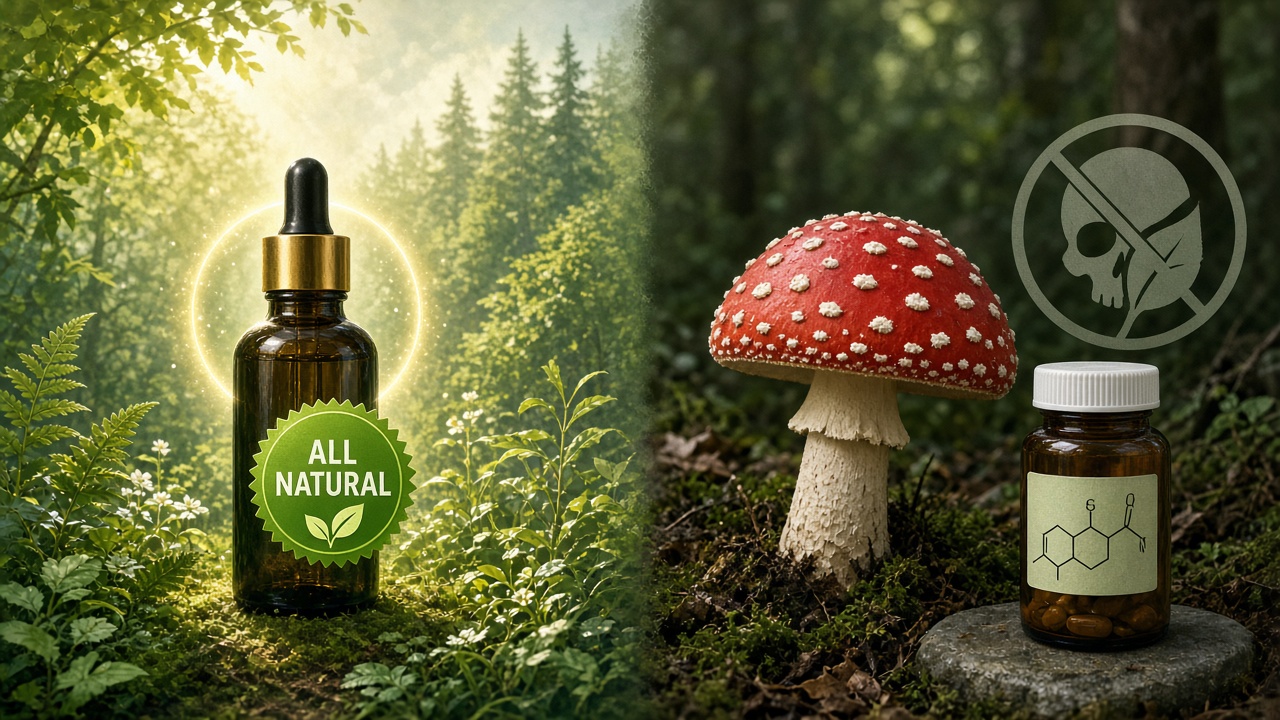
Standard forms:
|
|
Julian Baggini’s blunt summary still holds: even if we agree which things are natural, nothing automatically follows about value. John Stuart Mill made the same point in On Nature (1874): if “natural” licensed every practice found in nature—killing, disease, disaster—we would reject the rule; so we never really believed naturalness was sufficient.
On this site it sits next to other prestige appeals such as appeal to tradition and appeal to novelty: old / new / natural are all status labels pretending to be evidence.
Why “Natural” Is a Weak Warrant
- Vague — Is cooking natural? Vaccination? Clothing? Fire? The boundary is movable, so speakers can cherry-pick.
- Ambiguous — “Natural” may mean non-synthetic, traditional, wild, unprocessed, or merely “contains a plant extract.”
- Selective — Advocates praise natural foods and ignore natural toxins (arsenic, botulinum, tobacco, hemlock).
- Irrelevant — Outcomes that matter—toxicity, dose, efficacy, consent, environmental cost—need their own data.
A useful stress test (Mill’s challenge): Would you accept every natural process as good? If not, naturalness is not your real criterion.
Vs Related Fallacies
How is appeal to nature different from the naturalistic fallacy?
How is appeal to nature different from the moralistic fallacy?
| Move | Direction | Typical line |
|---|---|---|
| Appeal to nature | natural → good / unnatural → bad | “It’s all-natural, so it’s safe.” |
| Naturalistic fallacy / is–ought (broad use) | is (in nature) → ought | “Animals compete, so selfishness is moral.” |
| Moore’s naturalistic fallacy | defining “good” via natural properties | Metaethical claim about definitions of good |
| Moralistic fallacy | ought → is / must be natural | “Violence is wrong, so it can’t be natural.” |
| Appeal to tradition | old → good | “We’ve always done it this way.” |
| Appeal to novelty | new → good | “The latest formula must be better.” |
| Genetic fallacy | origin → merit | “It came from a lab, so it’s suspect.” |
Popular writing often says “naturalistic fallacy” for plain appeal-to-nature ads. For clarity here: appeal to nature = the marketing/debate trap; moralistic = its rough inverse; both should yield to evidence about harms and benefits.
Examples
What is an example of appeal to nature?
Example 1 — Food and wellness marketing
|
|
“Natural” does not equal nutritious or low-sugar. Check ingredients, dose, and evidence—not the halo word.
Example 2 — Medicine and “chemicals”
|
|
Everything you eat is chemistry. Arsenic is natural; many life-saving drugs are synthetic. Safety is about substance and dose, not the natural/synthetic tag. (BBC Future’s 2025 explainer notes the same pattern in toothpaste debates: “natural” replacements are sometimes synthetic; brushing itself is hardly “as nature intended.”)
Example 3 — Ethics and “the natural way”
|
|
Even if ancestral diets included meat, that does not settle present ethics, health, or environmental impact—Peter Singer’s standard rebuttal: describe nature honestly, then argue morals on their own grounds.
Example 4 — Social Darwinist residue
|
|
A description of selection (often oversimplified) is smuggled into a moral rule. That is appeal-to-nature / is–ought territory biologists reject when they want clear factual description without licensing cruelty.
Example 5 — Technology panic
|
|
Risk assessment needs allergenicity, gene flow, yield, and regulation data. “Unnatural” is not a toxicity study. Conversely, “natural breeding” is not automatic safety.
When “Natural” Can Be Relevant
When is “natural” a relevant argument?
Not never—as a pointer, not a proof:
- You prefer fewer novel additives → say that, and verify the label.
- A plant compound has a known pharmacology → cite the compound and trials.
- A process has lower measured pollution → cite the measurements.
- Ecological restoration aims at historical baselines → defend the baseline as a policy goal, not as cosmic goodness.
The non-fallacious move replaces “natural = good” with testable claims. The fallacious move stops at the adjective.
How to Respond
How can I respond to an appeal to nature?
- Define the term — “What do you mean by natural here?”
- Apply Mill’s test — “Would every natural toxin get a pass under your rule?”
- Separate label from outcome — “Safe/effective/ethical—what’s your evidence for that?”
- Flip the synthetic scare — “Unnatural” includes eyeglasses, antibiotics, and soap; ask which property actually matters.
- Watch the inverse — If they deny facts because the facts feel immoral, point to the moralistic fallacy.
Compact reply:
|
|
Related Fallacies
- Moralistic Fallacy — ought projected onto what nature “must” be
- Appeal to Tradition — antiquity as goodness (often pairs with “natural heritage”)
- Appeal to Novelty — newness as goodness (the marketing twin)
- Appeal to Emotion — purity, disgust, and “chemical” fear
- False Dilemma — natural vs synthetic as the only frames
- Hasty Generalization / cherry-picking — only the flattering natural examples
- Conspiracy Theory framing — “they hide that natural cures…”